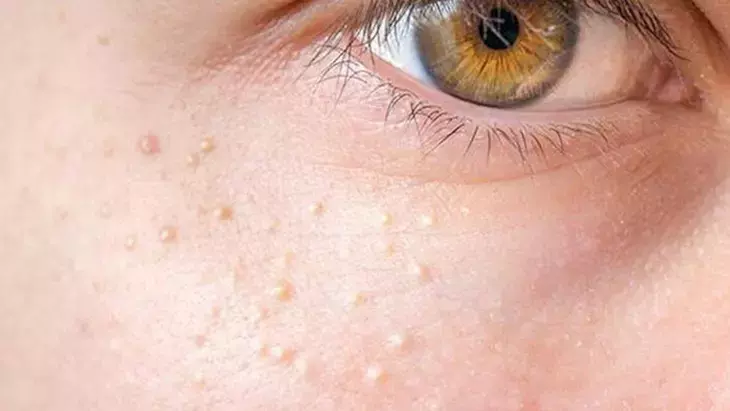
Sometimes, a very small thing catches a person’s eye. Then they cannot stop noticing it. Like that yellowish area that appears on the eyelid. At first, it is often ignored. People think it will go away. Maybe it is due to tiredness. Maybe it is a temporary change in the skin. But the days pass, and that appearance remains there. Sometimes, it even becomes a little more noticeable.
When it is around the eyes, people tend to focus on it even more. Because it is right in the center of the face. It is not easy to hide. Covering it is not always possible either. When looking in the mirror, the eye goes straight there. It becomes noticeable in photos. During close conversations, it comes to mind. Something that seems small at first then grows bigger in the mind.
When talking about a yellow fatty deposit on the eyelid, one of the most common conditions encountered is xanthelasma. The name may sound a little unfamiliar, but its appearance is familiar. It is usually seen near the inner corner of the eye, on the upper or lower eyelid, as yellowish, slightly raised, soft plaques. Most of the time, it does not cause pain. There is no itching either. That is exactly why it can be neglected for a long time.
But this part is important. These yellow areas usually do not behave like a simple layer of dirt. They do not go away when wiped. They do not disappear when cream is applied. Because the issue is not only on the surface. It may be related to fat-containing cells accumulating under the skin. In other words, it may not be simple enough for a person to solve on their own at home.
What Exactly Is the Yellow Fatty Deposit on the Eyelid?
The most common name for these formations is xanthelasma. It usually appears near the inner part of the eyelids. It is yellow in color. Sometimes it looks flat, and sometimes it is slightly raised. In the beginning, it starts like a small spot. Then it can slowly expand. It may appear on one side. It can also be seen in both eyes.
One of the things it is most often confused with is a pimple or a sebaceous cyst. But xanthelasma is not that kind of structure. It is not something that can be squeezed. It does not have a visible tip. It is not inflamed at all. It has more of a plaque-like appearance that seems integrated with the skin. It stays silent. It does not cause physical pain. But visually, it remains noticeable.
In some people, this condition remains only an aesthetic issue. In others, there may be other underlying factors. Especially issues related to cholesterol and fat metabolism may come to the agenda. So it may not be very accurate to see this yellow area as just a superficial spot and ignore it.
Why Does It Occur?
This is already the most frequently asked question. Why did it appear?
There is no single reason. Sometimes there is a similar condition in the family. A grandmother has it, the mother has it, and then it appears in the person as well. Sometimes it is related to blood fats. Cholesterol, triglycerides, and certain metabolic tendencies may be involved. But there is no rule that every person with xanthelasma must have high cholesterol. The opposite is also possible. It can also be seen in someone whose values are normal.
Age can also be a factor. Because skin structure changes over time. Supporting tissues change, metabolism does not remain the same, and some accumulations under the skin become more visible. Diabetes, thyroid problems, and certain liver-related conditions may also accompany the picture. In short, sometimes the issue is not only the skin. It is also somewhat related to the general functioning of the body.
I think the most important point is this: this appearance should not be underestimated. Because it does not cause pain, it may be assumed to be unimportant. However, things that progress silently sometimes require more attention.
How Can It Be Recognized?
Actually, its appearance is often quite typical. A yellow or yellowish-white area is seen on the eyelid, especially near the inner part. It may be slightly raised. It looks soft. It appears like a plaque attached to the skin.
People usually remember the moment they noticed it very clearly. They see it while applying makeup. They notice it when they get closer to the mirror. It catches their attention on the front camera of the phone. Because there is no pain. No itching. Most of the time, there is no feeling of discomfort either. There is only the appearance.
The following features are more suggestive of xanthelasma:
- A yellowish color change on the eyelid
- Located especially near the inner corner of the eye
- A flat or slightly raised appearance
- A soft appearance that seems integrated with the skin
- No pain, burning, or itching
- Becoming more noticeable over time
- Appearing on one side or on both sides
Of course, there are other things that can be confused with it. Small white dots called milia are different. Sebaceous cysts are different. Wart-like formations are different. Inflammatory problems behave differently anyway. They become red, sensitive, and sometimes painful. Xanthelasma, on the other hand, usually stays calm. But it leaves a permanent-looking appearance.
Does It Go Away at Home?
People naturally want to try this first. They wonder whether a cream would work, whether peeling would help, or whether applying something natural would reduce it. This is very understandable. But it is necessary to be realistic. Xanthelasma is not a formation that tends to disappear completely on its own. Especially if it has become noticeable.
Since the problem is not a simple layer attached to the surface of the skin, it is not expected to be completely erased with random products applied from above. Harsh rubbing, scraping, or squeezing can lead to even worse results. Because the eye area is very sensitive. It is easily irritated. Scarring may occur. Color changes may occur.
Therefore, damaging the area while trying to solve it at home often does not fix the problem. On top of that, it may add a new problem.
How Does the Yellow Fatty Deposit on the Eyelid Go Away?
The first step here is to understand whether this is really xanthelasma. Because not every yellow bump is the same thing. Any intervention performed without the correct diagnosis remains somewhat like a blind attempt.
If the spot is small, not growing, and the person is not very bothered by its appearance, follow-up may sometimes be enough. But if the area is expanding, becoming more noticeable, or the person is having difficulty accepting it aesthetically, treatment options are evaluated.
The treatment method is not the same for everyone. Because the depth of the lesion, its spread, its location, skin structure, and the person’s general health status are all considered together. In some people, more superficial applications may come to the forefront. In others, laser-type approaches may be discussed. In some cases, surgical removal may be planned.
The important thing here is this: to proceed without disturbing the natural structure of the eyelid. Because the eye area is not a region that tolerates mistakes easily. The work is done in a very small area, but its effect is significant.
What Is the Process Like After Treatment?
After the procedure is performed, everything does not end at that moment. The period afterward is also important. Sometimes, at least as important as the procedure itself.
Since the eye area has thin skin, redness, mild sensitivity, crusting, or temporary color changes may be seen. These are often part of the process. But how the person treats the area during this period seriously affects the result.
The most important thing is to leave the area alone. Not to touch it constantly. Not to rub it. If there is crusting, to wait for it to fall off on its own. Sun protection is also important. Because healing skin can become more vulnerable to external factors.
There is also the matter of patience. People expect a smooth appearance immediately, but the skin needs time to recover. Especially in a sensitive area like the eyelid, a little more care is required.
Can It Recur?
Unfortunately, it can. This is also something that needs to be discussed. Because removing only the visible area does not always eliminate the underlying tendency. If the person has a genetic predisposition, a tendency related to fat metabolism, or if the skin is prone to the same type of accumulation again, similar plaques may form over time.
Therefore, the issue is not only removing the spot. It is also about seeing the overall picture. If necessary, a metabolic evaluation should be performed. Attention should be paid to nutrition, weight control, and general health. None of these may provide definite protection on their own, but they can be supportive in reducing the risk of recurrence.
I think the most reasonable approach here is this: when a new yellow area is noticed, not to wait for it to grow. It should be evaluated while it is still small. Because dealing with things noticed at an early stage is often easier.
When Should It Be Taken Seriously?
Actually, it is useful to take it seriously as soon as it is noticed. Not in the sense of panic. In the sense of acting consciously. Especially if the spot is growing, appearing in both eyes, becoming increasingly noticeable, or if there are similar cases in the family, it is a good idea to get an evaluation.
Because sometimes people think only in terms of aesthetic discomfort. However, some skin findings may also provide clues about the body. For this reason, seeing the yellow spot on the eyelid only as a cosmetic issue may be incomplete.
The correct diagnosis is more important than anything here. Because not every yellow spot is the same. If the formation in question is xanthelasma, it should be approached accordingly. Instead of dealing with random products at home, it is much more reasonable to get a controlled evaluation suitable for the structure.
The most accurate approach is probably this: not to proceed with hearsay methods in a sensitive area like the eye area. Because a small mistake made there can turn into another issue that is more difficult to solve. The correct step is often simpler. First, understand what you are dealing with. Then proceed accordingly.