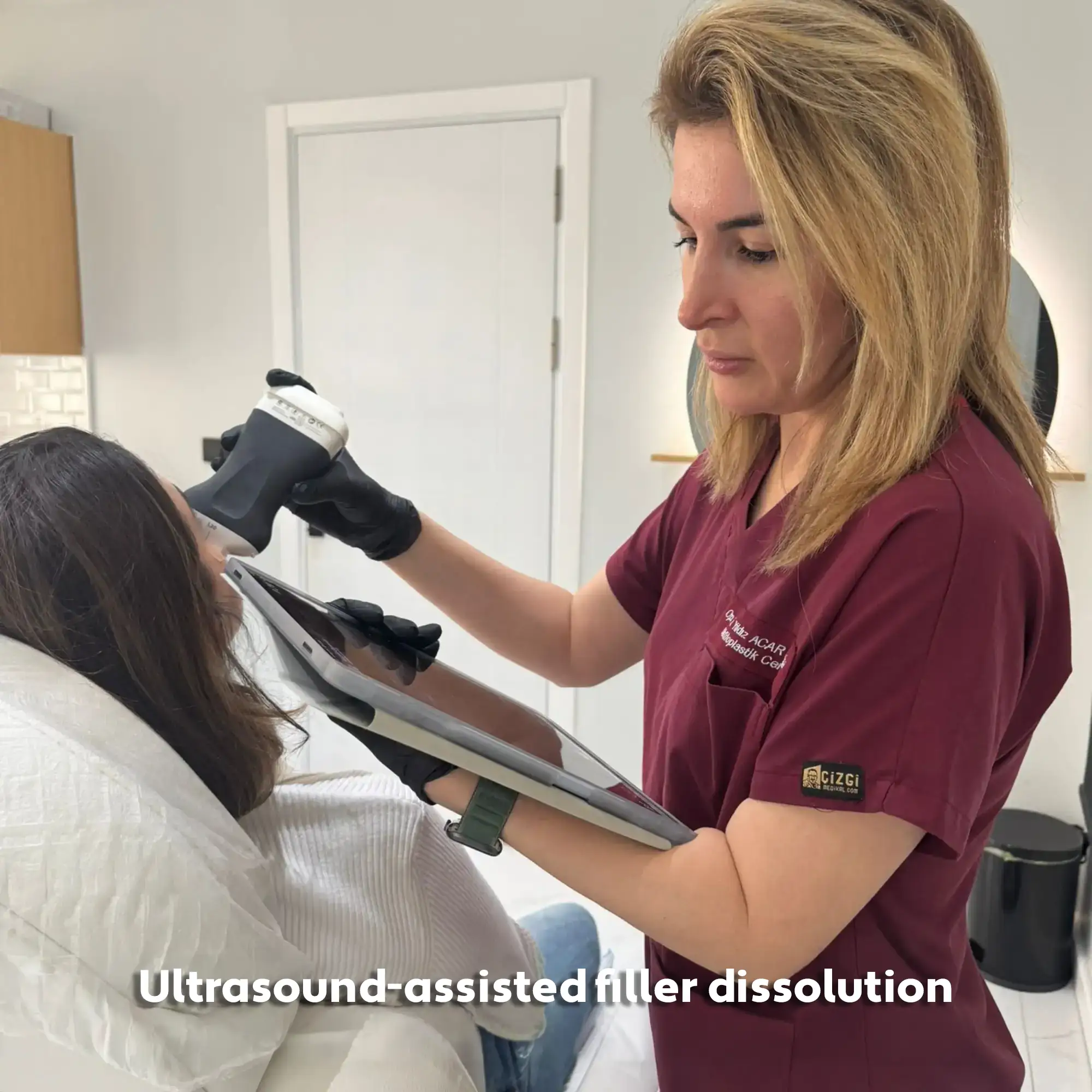
What Is Ultrasound-Guided Under-Eye Filler Dissolving?
Ultrasound-guided under-eye filler dissolving is the controlled dissolving of filler with hyaluronidase by visualizing the location of the filler.
This method is especially applied for under-eye filler that has been placed incorrectly or causes swelling. A medical ultrasound device clearly shows the depth and spread of the filler. This allows targeted intervention without damaging unnecessary tissue. The hyaluronidase enzyme used breaks down hyaluronic acid-based filler. The procedure is usually short and performed in a clinical setting. Ultrasound-guided filler dissolving provides safer results. Problems such as bruising, edema, or asymmetry are corrected in a controlled way.

Ultrasound-Guided Filler Dissolving
Ultrasound-guided filler dissolving is a method of seeing the location, depth, and spread of the filler under the skin with ultrasound imaging and, if intervention is needed, performing it in a more targeted way. Here, the role of ultrasound is mostly to guide the procedure. In other words, ultrasound alone does not dissolve the filler; if the filler is hyaluronic acid-based, a dissolving approach with an enzyme called hyaluronidase is generally used. Ultrasound can guide the decision on where and at what intensity the enzyme should be applied.
This guidance becomes important in an area like the under-eye, where even millimetric differences can change facial expression. Because unnecessary dissolving performed in the wrong place may create an unwanted hollow appearance or tissue imbalance. Ultrasound evaluation helps clarify the target and build a more controlled plan.
Does Dissolving Under-Eye Filler Damage the Eye?
The under-eye area is a special anatomical region that requires millimetric precision. Therefore, filler dissolving should not be planned like a standard procedure; it should be carefully planned by a physician who has a strong command of the eye area anatomy.
Thanks to Dr. Yıldız Acar Ebcim’s specialization in ophthalmology & surgery and her experience in eye anatomy, the filler dissolving procedure is planned in a controlled, measured, and safe way to protect visual health.
Why Is Under-Eye Filler Dissolved?
Under-eye filler is usually performed to reduce a tired appearance, soften hollowness, and make the under-eye transition look smoother. However, in some people, the filler holds edema over time and the appearance of swelling becomes more noticeable. In others, because the filler remains close to the surface, a bluish-gray reflection may be seen. Sometimes complaints such as asymmetry, a lumpy feeling, or a bag-like appearance may occur.
This picture does not always mean that the filler was applied poorly. Under-eye anatomy varies from person to person; factors such as skin thinness, distribution of fat tissue, and lymphatic circulation affect how the filler behaves. For this reason, under-eye filler dissolving is sometimes planned not to completely reverse the procedure, but as a small correction to return to a more natural appearance.
Why Is Ultrasound Especially Useful Under the Eyes?
Under-eye swelling is often not due to a single cause. Lack of sleep, allergies, tendency toward sinusitis, salt consumption, hormonal fluctuations, and even the habit of rubbing the face can increase under-eye edema. When this combines with the presence of filler, the problem may be perceived as if it is caused by the filler. Ultrasound helps show where the filler material actually is, reducing incorrect assumptions.
In addition, because the vascular and soft tissue layers are close to each other in the under-eye area, the intervention plan should be more meticulous. Seeing the depth of the filler with ultrasound can make it easier to approach the target more accurately. Thus, the ultrasound-guided under-eye filler dissolving approach helps both reduce unnecessary procedures and aim for more predictable results.
Is Every Under-Eye Problem Caused by Filler?
This is the basic question that everyone with under-eye filler should ask. Because under-eye darkness is pigment-related in some people; in other words, the color comes from the distribution of melanin in the skin, not from blood vessels or the reflection of filler. In some people, hollowness is dominant, but skin quality is weak; filler alone is not enough. In others, under-eye bags are the main problem, and filler can make the bag appearance more noticeable.
Ultrasound evaluation supports this distinction, but it does not solve everything on its own. In an experienced evaluation, the person’s complaint, facial structure, appearance under light, tissue movement, and tendency toward edema are considered together. In this way, the decision to dissolve under-eye filler is made not only according to momentary dissatisfaction, but according to a broader picture.

How Is Under-Eye Filler Dissolving with Hyaluronidase Performed?
If the under-eye filler is hyaluronic acid-based, the dissolving procedure is usually performed with hyaluronidase. This enzyme helps reduce volume by breaking down the structure of the filler. When applied under ultrasound guidance, the aim is to deliver the enzyme more precisely to the layer where the filler is located. Especially in sensitive areas like the under-eye, proceeding with small doses may reduce the risk of excessive dissolving.
In the first hours after the application, swelling may seem to increase; this is often the effect of the injection and the temporary reaction of the tissue. Then, as the filler decreases, the appearance gradually changes. In some people, the change is noticed on the same day, while in others it becomes clearer within a few days. Patience is important in the under-eye area; because it is not correct to evaluate the final appearance before the tissue calms down.
Number of Sessions and Timing in the Ultrasound-Guided Dissolving Process
In the ultrasound-guided under-eye filler dissolving process, the number of sessions varies depending on the amount of filler, its spread, and how long it has been there. Filler accumulated at a single point may sometimes decrease noticeably in one session. In fillers that are more spread out or appear to have integrated with the tissue for a long time, a gradual approach gives a more balanced result. Gradual dissolving is a safer path, especially for people who want to preserve their facial expression.
There is also an important detail regarding timing: it is normal to see fluctuations for a few days after the procedure. Under-eye edema may change with factors such as morning-evening differences, salt consumption, and sleep routine. Therefore, result evaluation is usually performed after allowing a certain interval for the tissue to calm down. Repeating the intervention too quickly may lead to unnecessary dissolving.
Sensation and Comfort During the Procedure
Since the under-eye area is sensitive, mild stinging, burning, or a feeling of pressure may be felt during the procedure. Regional numbing methods may be preferred to increase comfort. In ultrasound-guided application, the imaging process is also part of the session; in other words, it is not only the injection but also the stage of finding the correct target that takes time. Although this stage may sometimes seem unnecessary to the person, it is actually the foundation of a safer and clearer intervention plan.
Mild bruising or swelling may be seen after the procedure. Since the tissue around the eyes is thin, even a small reaction appears more noticeable. This is usually temporary, but arranging your social plans according to the session day provides comfort.
Advantages of Ultrasound-Guided Filler Dissolving
The biggest advantage of ultrasound-guided filler dissolving is that it clarifies the target. Under-eye swelling is not always exactly above the filler; the filler may have shifted to the side, settled deeper, or spread along a different line. Ultrasound makes it easier to focus on wherever the filler is located. This may reduce the need to apply enzyme over an unnecessarily wide area.
The second advantage is that the plan becomes more personalized. Not every under-eye area is the same; in some people hollowness is dominant, in others bagging is dominant, and in others darkness is more noticeable. An ultrasound-supported evaluation gives a clearer idea of whether filler dissolving will really be beneficial. This both regulates expectations and reduces disappointment.
Post-Procedure Care and Things to Consider
Post-procedure care directly affects the result in a sensitive area such as the under-eye. In the first days, avoiding rubbing the area, reducing exposure to hot showers and excessive heat, and limiting intense exercise for a short time may help reduce swelling. Gentle cleansing and a simple moisturizing routine are sufficient for most people. It is a good idea to take a break from irritating ingredients and harsh peeling applications around the eyes.
Gentle cold application at short intervals may be soothing to reduce swelling. However, it is important not to apply excessive pressure and not to keep it on long enough to freeze the skin. Sun protection is also valuable for the eye area; because sensitized tissue may be more prone to color changes. Maintaining care discipline not only for a few days, but at least until the tissue completely calms down, provides healthier results.
Possible Side Effects and Risks
The most common conditions after under-eye filler dissolving are swelling, redness, bruising, and sensitivity. These are usually temporary. More rarely, allergic reactions may occur; therefore, it is important for people with a history of allergies to share this clearly before the procedure. Another risk is the perception of volume loss as a result of excessive dissolving. If the filler has created a balance in the face for a long time, the person may suddenly feel more hollow when it is dissolved. This is not always permanent, but a gradual approach reduces this risk.
There is also a critical safety note here: after filler procedures, if there is severe and increasing pain, rapidly spreading color change, a noticeable feeling of coldness, or an unusual symptom related to vision, waiting is not the right approach. Such situations require urgent medical evaluation. Since the under-eye area is sensitive, risk management comes before aesthetic concerns.
Can Filler Be Applied Again After Ultrasound-Guided Under-Eye Filler Dissolving?
Yes, some people prefer to have filler again after dissolving; however, correct timing is important. First, the tissue should calm down, edema should decrease, and the real picture should appear. Otherwise, refilling may cause the same complaints again. If filler is planned again, the goal is usually to achieve a more natural transition with a smaller amount and in a more correct layer.
In addition, if the only cause of under-eye problems is not filler, supportive applications that strengthen skin quality or lifestyle adjustments may come to the agenda instead of refilling. At this point, the best plan is built based on the person’s facial structure and the source of their complaint.