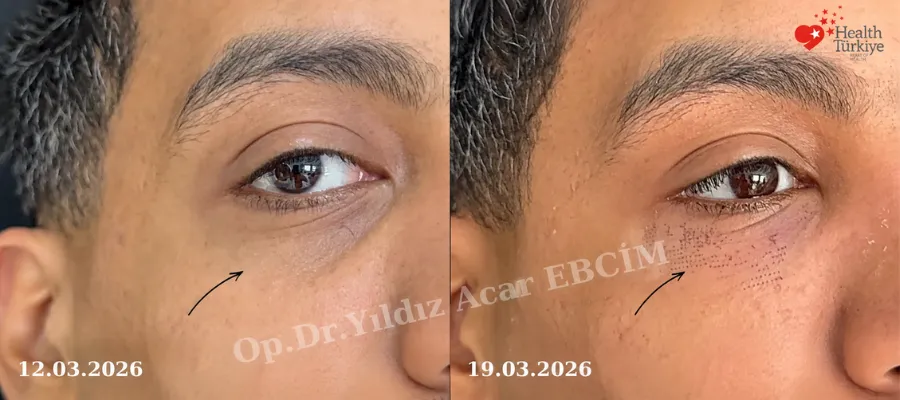
Infraorbital implant surgery is a surgical procedure designed to increase structural support and projection along the lower bony border of the eye socket. In some patients, the infraorbital rim may naturally sit further back than the surrounding facial structures, creating a flatter midface, a more prominent appearance of the eyes, or a deeper transition between the lower eyelid and cheek.
The appearance of the under-eye area is not determined by the skin alone. Bone structure, fat compartments, ligaments, lower eyelid position, cheek volume, and the relationship between the eye and midface all contribute to the overall result.
For this reason, infraorbital implant surgery should not be viewed simply as a procedure that “fills the under-eye area.” Its main purpose is to address skeletal support in carefully selected patients whose facial anatomy shows insufficient projection of the lower orbital rim.
Not every person with under-eye hollowness requires an implant. Dark circles, tear trough deformity, lower eyelid bags, skin laxity, loss of cheek volume, pigmentation, or age-related tissue changes can produce a similar appearance. A detailed examination is therefore necessary before deciding whether the underlying issue is primarily skeletal or related to soft tissue.
What Is the Infraorbital Rim?
The infraorbital rim is the lower bony border of the eye socket, also known as the orbit. It forms an important structural transition between the lower eyelid and upper cheek.
This bony area plays an important role in supporting the soft tissues around the eye. Its projection can also influence how prominent the eyes appear in relation to the rest of the face.
When the infraorbital rim has adequate forward projection, the transition between the lower eyelid and cheek may appear more supported.
If the bony rim sits further back, the eye may appear more prominent, the under-eye region may look hollow, and the midface may appear flatter.
For this reason, evaluation of the eye area should include not only skin and fat tissue but also the underlying skeletal anatomy.
What Is Infraorbital Implant Surgery?
Infraorbital implant surgery involves placing a carefully selected implant over the lower orbital rim to increase skeletal projection and support.
The implant is positioned at the bone level rather than superficially beneath the skin. The goal is therefore not simply to create temporary volume, but to modify the structural relationship between the eye, lower orbital rim, and cheek.
During surgical planning, several anatomical factors are considered, including:
- Projection of the infraorbital rim
- Position of the eyeball
- Lower eyelid position
- Midface and cheek projection
- Facial symmetry
- Location of the infraorbital nerve
- Previous eyelid or orbital surgery
- Soft tissue thickness
In some patients, infraorbital implant surgery may be performed as a standalone procedure.
In others, it may be combined with lower eyelid surgery, canthopexy, canthoplasty, midface lifting, fat repositioning, or fat transfer depending on the anatomy and treatment goals.
What Is a Negative Vector and How Is It Related to the Infraorbital Rim?

The term “negative vector” is frequently used when evaluating the relationship between the eye and the midface.
In a negative vector facial structure, the most anterior point of the eyeball projects further forward than the lower orbital rim and upper cheek.
In simple terms, the eye appears to sit further forward while the skeletal support beneath it is positioned further back.
This anatomy may contribute to:
- A more prominent appearance of the eyes
- A deeper lower eyelid-cheek junction
- Increased under-eye shadowing
- Reduced skeletal support beneath the lower eyelid
- A flatter midface appearance
Negative vector anatomy is especially important when planning lower eyelid surgery because the amount of skeletal support beneath the lower eyelid may influence both the aesthetic result and eyelid position.
However, having a negative vector does not automatically mean that an infraorbital implant is necessary.
Lower eyelid tone, globe position, cheek volume, skin quality, facial proportions, and patient expectations must all be considered before surgery is recommended.
Who May Be Suitable for Infraorbital Implant Surgery?
Infraorbital implant surgery may be considered in carefully selected patients whose primary concern is related to insufficient skeletal support beneath the eyes.
Possible indications may include:
- Naturally recessed infraorbital rims
- Significant negative vector facial anatomy
- Insufficient midface skeletal projection
- Eyes that appear prominent relative to the cheekbones
- Structural hollowness between the lower eyelid and cheek
- Post-traumatic loss of orbital rim contour
- Noticeable asymmetry between the two sides of the face
- Selected cases following previous eyelid or orbital surgery
The most important step is identifying the actual cause of the patient’s concern.
For example, a person whose dark circles are primarily caused by pigmentation would not necessarily benefit from skeletal augmentation.
Similarly, a person with isolated lower eyelid fat bags may require a different surgical approach.
Infraorbital implant surgery is therefore most appropriate when skeletal anatomy is a significant component of the concern.
How Is Surgical Planning Performed?
Because the infraorbital area lies close to the eye, important nerves, and delicate soft tissues, detailed planning is important.
The face is typically evaluated from both frontal and side views.
The surgeon may examine:
- Lower eyelid position
- Eyelid tone
- Amount of visible sclera
- Eye projection
- Tear trough depth
- Cheek projection
- Facial asymmetry
- Bone structure
- Previous surgical changes
In selected patients, imaging may be used to assess the bony anatomy more precisely.
Three-dimensional imaging may also be useful when a patient-specific implant is being considered.
Patients who have previously undergone lower eyelid surgery, orbital surgery, facial trauma, or facial implant procedures should inform their surgeon because previous procedures may affect the surgical plan.
How Is Infraorbital Implant Surgery Performed?
The exact surgical technique depends on the patient’s anatomy, implant design, and whether other procedures are being performed at the same time.
Different surgical approaches may be used to access the infraorbital rim.
In selected patients, the surgeon may use a transconjunctival approach, which provides access through the inside of the lower eyelid without creating a traditional external skin incision.
Other approaches may be preferred depending on the anatomy and the combination of procedures planned.
Once the infraorbital rim has been accessed, a pocket is created at the appropriate level over the bone.
The implant is then positioned according to the planned contour and projection.
Symmetry is carefully evaluated during surgery.
Depending on the implant material and surgical technique, fixation may be used to help maintain the implant in the intended position.
Special attention must be paid to the infraorbital nerve.
This nerve provides sensation to areas including the cheek, side of the nose, upper lip, and lower eyelid region.
For this reason, implant placement and surgical dissection must be carefully planned.
The duration of surgery varies depending on whether the procedure is performed alone or together with other facial or eyelid procedures.
What Types of Infraorbital Implants Can Be Used?
Different biocompatible materials may be used for facial implants.
Possible materials used for infraorbital augmentation may include silicone, porous polyethylene, and selected patient-specific implant materials.
The choice of implant depends on more than the material itself.
Important factors include:
- Thickness
- Length
- Shape
- Projection
- Position over the orbital rim
- Symmetry between both sides
- Soft tissue coverage
Standard implants may be suitable for certain facial anatomies.
In patients with significant asymmetry, previous trauma, complex skeletal anatomy, or unusual contour requirements, custom implants may be considered.
Patient-specific implants may be designed using three-dimensional imaging data to better match the individual bone structure.
However, custom implants are not necessary in every patient.
The final choice should be based on anatomy, surgical goals, and the surgeon’s assessment.
Is an Infraorbital Implant the Same as Under-Eye Filler?
No.
Infraorbital implants and under-eye fillers work at different anatomical levels and address different problems.
Under-eye filler is a non-surgical treatment that may be used in selected patients to add soft tissue volume and reduce the appearance of the tear trough.
Infraorbital implants are placed at the skeletal level and are designed to increase bone-level support and projection.
For this reason, the decision between filler and implant should not simply be based on which treatment lasts longer.
The more important question is whether the underlying concern is primarily related to soft tissue volume or skeletal anatomy.
Some patients may benefit from fat transfer or other soft tissue treatments, while others may require skeletal augmentation.
Can Infraorbital Implant Surgery Be Combined With Other Procedures?
Yes, depending on the patient’s anatomy.
The eye area contains several structures that influence one another, which means a combined approach may sometimes provide a more complete correction.
Procedures that may be considered together with infraorbital augmentation include:
- Lower blepharoplasty
- Canthopexy
- Canthoplasty
- Midface lifting
- Fat repositioning
- Fat grafting
However, combining more procedures does not automatically mean a better result.
Each additional procedure increases the extent of surgery and may affect recovery.
The treatment plan should therefore include only procedures that are anatomically necessary and appropriate for the patient.
Recovery After Infraorbital Implant Surgery
Swelling and bruising around the lower eyelid and cheek area can occur after surgery.
The degree of swelling varies depending on the extent of surgery, implant placement, and whether other procedures were performed at the same time.
During the first days, one side may appear more swollen than the other.
This does not necessarily indicate a problem because postoperative swelling is rarely perfectly symmetrical.
The appearance during the early recovery period should not be considered the final surgical result.
Visible swelling generally decreases gradually over the following weeks.
The time required to return to social activities varies between patients and depends on the extent of surgery.
Deeper tissue swelling may take longer to completely resolve.
Patients should follow postoperative instructions carefully, protect the area from trauma, and attend scheduled follow-up appointments.
What Are the Risks of Infraorbital Implant Surgery?
As with any surgical procedure, infraorbital implant surgery involves potential risks and complications.
Temporary swelling, bruising, tenderness, tightness, and altered sensation may occur during recovery.
Because surgery is performed near the infraorbital nerve, temporary numbness involving the cheek, upper lip, side of the nose, or lower eyelid region may occur.
Other potential complications can include:
- Infection
- Bleeding
- Hematoma
- Asymmetry
- Implant malposition
- Implant movement
- Visible or palpable implant edges
- Prolonged swelling
- Changes in lower eyelid position
- Sensory changes
- Need for implant revision
- Need for implant removal
The likelihood and significance of these risks vary depending on the individual patient, anatomy, implant material, surgical technique, and previous procedures.
Patients who have undergone previous lower eyelid or orbital surgery may require additional consideration during surgical planning.
Is an Infraorbital Implant Permanent?
Infraorbital implants are not designed to dissolve in the way temporary injectable fillers do.
In the absence of complications, an implant may remain in place for many years.
However, the word “permanent” should not be interpreted as meaning that an implant can never be revised or removed.
Revision or removal may be required because of:
- Infection
- Implant position
- Asymmetry
- Trauma
- Changes in aesthetic preference
- Changes in surrounding tissues over time
It is also important to understand that facial aging continues after implant surgery.
Although the skeletal projection created by the implant may remain, the skin, fat compartments, ligaments, and other facial tissues will continue to change with age.
Infraorbital Implant Surgery Cost in 2026
Infraorbital implant surgery cost in 2026 cannot be determined using one standard price for every patient.
The procedure may vary significantly depending on the implant, surgical plan, hospital requirements, and whether additional procedures are required.
Factors that may influence the 2026 infraorbital implant surgery price include:
- Type and material of the implant
- Standard or custom-made implant
- Unilateral or bilateral surgery
- Need for three-dimensional imaging or planning
- Type of anesthesia
- Hospital and operating room costs
- Surgical complexity
- Duration of surgery
- Additional procedures performed during the same operation
For example, a patient requiring a custom implant designed using three-dimensional imaging may have a different treatment plan from a patient suitable for a standard implant.
Likewise, combining infraorbital augmentation with lower blepharoplasty or canthoplasty will change the overall scope of surgery.
For this reason, an exact 2026 price can usually be determined only after examination, assessment of the facial anatomy, and selection of the appropriate surgical plan.
Why Should the Entire Eye Area Be Evaluated?
The lower eyelid and under-eye region are created by several anatomical structures working together.
These include the skin, muscles, orbital fat, ligaments, orbital rim, cheek tissues, and the position of the globe.
A hollow appearance beneath the eyes does not always indicate a skeletal problem.
In one patient, bone deficiency may be the primary issue.
In another patient, the appearance may result mainly from:
- Lower eyelid fat bags
- Tear trough deformity
- Skin laxity
- Midface volume loss
- Pigmentation
- Eyelid position
- Soft tissue descent
In some patients, several of these factors may exist simultaneously.
The purpose of facial assessment is therefore not simply to add volume to one area, but to understand how the eye, lower eyelid, cheek, and skeletal framework interact.
Frequently Asked Questions About Infraorbital Implant Surgery
Can an infraorbital implant be felt under the skin?
The implant is generally positioned at the bone level beneath the soft tissues.
Whether an implant can be felt may depend on its thickness, position, material, and the amount of soft tissue covering it.
Careful selection of implant size and placement is important to reduce the risk of visible or palpable edges.
Does an infraorbital implant change eye color or eyesight?
No.
The purpose of the procedure is not to change the eye itself.
The implant is positioned along the bony structure beneath the eye.
However, because surgery takes place close to the eye and orbital structures, appropriate preoperative evaluation is important.
Can the implant be placed on only one side?
Yes, unilateral surgery may be considered in selected patients.
This may be appropriate in cases involving trauma, congenital asymmetry, previous surgery, or significant differences between the two sides.
Natural facial asymmetry should also be taken into account during planning.
Can an infraorbital implant be removed later?
Yes.
An implant may be revised or removed if necessary.
The complexity of removal depends on the implant material, method of fixation, surrounding scar tissue, and the type of previous surgery.
Does an infraorbital implant completely eliminate dark circles?
Not necessarily.
Dark circles can have several causes, including pigmentation, thin skin, visible blood vessels, genetics, shadowing, and skeletal anatomy.
Increasing skeletal support may change the way light and shadow fall across the under-eye region in some patients, but it does not directly treat pigmentation.
Will an infraorbital implant change facial expression?
Increasing skeletal projection can influence the visual relationship between the eyes, lower eyelids, and cheeks.
The aim is generally to create support that remains in proportion with the rest of the face rather than dramatically alter facial identity.
For this reason, implant size and projection should be carefully selected.
Can eyelid surgery be performed in the future after an infraorbital implant?
Yes, future eyelid surgery may still be considered if needed.
However, the position of the existing implant and any tissue changes caused by previous surgery must be taken into account.
Patients should always inform their surgeon about previous infraorbital implant surgery.
Is infraorbital implant surgery performed for both women and men?
Yes.
Suitability is determined by anatomy rather than gender.
However, facial proportions, skeletal structure, and aesthetic goals may differ between patients.
The implant should therefore be selected and positioned according to the individual facial anatomy.