

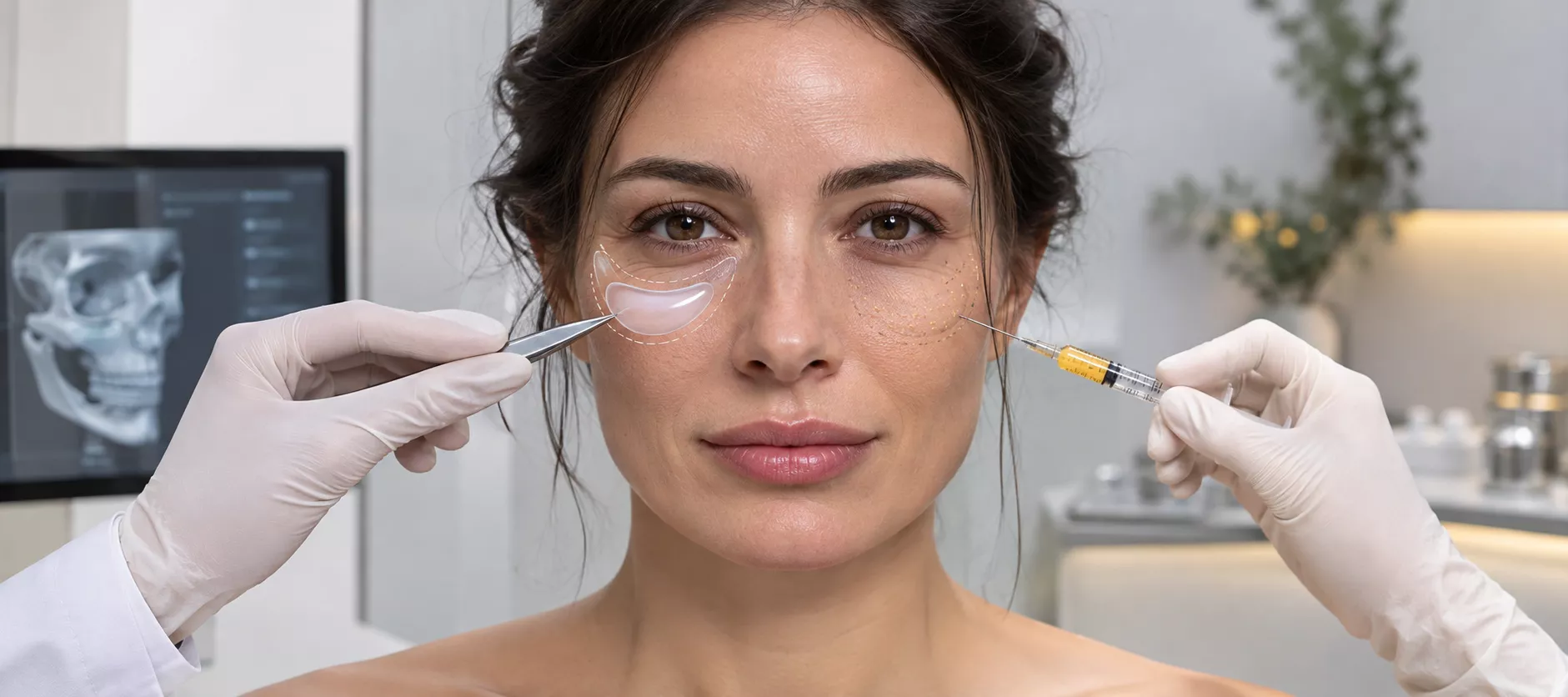
This is the main difference in the comparison of infraorbital implants vs fat injection. An infraorbital implant adds structural support to the bone beneath the eye socket. Fat injection, on the other hand, aims to restore lost soft tissue volume using the patient’s own fat. Choosing the right treatment requires understanding not only the visible hollow but also what causes it.
What Is an Infraorbital Implant?
An infraorbital implant is a medical device placed along the lower bony rim of the eye socket to increase its forward projection and structural support. It may help create a more balanced appearance between the eyes and cheeks, particularly when the bone beneath the lower eyelid lacks sufficient projection. This procedure is not the same as ordinary under-eye filler. Volume is added at the bone level rather than directly beneath the skin.
During infraorbital implant surgery, the size and position of the implant, along with the support it provides to the lower eyelid, are important considerations. Surgical planning involves examining the face from both frontal and side views. Eyes that appear prominent are not always caused by the position of the eyeballs themselves. The surrounding bone structure can also influence this appearance.
What Is Under-Eye Fat Injection?
Fat injection is a procedure in which fat is collected from another part of the body, prepared, and transferred in small amounts to suitable areas beneath the eyes. Fat taken from areas such as the abdomen or thighs is placed using fine cannulas. The goal is to reduce tear trough hollowness and create a smoother transition between the lower eyelid and cheek.
Under-eye fat injection does not change the underlying bone structure. For this reason, it is mainly considered when soft tissue volume loss is the primary concern. Some of the transferred fat is gradually absorbed by the body, while the portion that survives may remain for many years. The fullness seen immediately after the procedure should not be considered the final result.
Key Differences Between Infraorbital Implants and Fat Injection
Both procedures aim to reduce the appearance of under-eye hollowness. However, they work at different tissue levels, involve different techniques, and behave differently over time. One creates stable support over the bone, while the other restores volume through living fat tissue that integrates with the surrounding tissues.
| Comparison | Infraorbital Implant | Fat Injection |
|---|---|---|
| Target Area | Bony orbital rim | Soft tissue |
| Material Used | Biocompatible implant | Patient’s own fat |
| Procedure Type | Surgical implant placement | Fat harvesting and transfer |
| Main Purpose | Structural support | Restoring lost volume |
| Long-Term Results | Support remains while the implant stays in place | Some transferred fat may be absorbed |
| Additional Treatment | Surgical revision may be necessary | Additional fat transfer may be necessary |
Why Does the Cause of Under-Eye Hollowness Matter?
Two people may have under-eye hollows that look equally deep but develop for completely different reasons. A recessed orbital rim, loss of cheek volume, protruding under-eye fat bags, and thinning skin are separate concerns. Several of these factors may also occur together. This is why choosing a procedure based on a single photograph can be misleading.
Under-eye volume loss often becomes more noticeable with age. However, pronounced hollowness can also occur at a young age due to inherited bone structure. During an examination, the position of the lower eyelid, cheek support, skin quality, and location of the tear trough are assessed together.
Who Is a Suitable Candidate for Infraorbital Implants?
Infraorbital implants may be considered for individuals whose under-eye appearance is mainly caused by insufficient skeletal support. Not every case of dark circles or hollowness requires an implant. The structure of the lower eyelid and the position of the eyeball are particularly important when considering surgery.
-
People with a naturally recessed lower bony rim of the eye socket.
-
People with a noticeable difference in structural support between the eyes and midface when viewed from the side.
-
People with bone-related under-eye hollowness that cannot be adequately corrected by adding fat alone.
-
People whose eyelid support and facial anatomy are found suitable for surgery during examination.
Who Is a Suitable Candidate for Under-Eye Fat Injection?
Fat transfer is generally considered when there is a loss of soft tissue volume. A prominent tear trough, a sharp transition between the cheek and lower eyelid, and reduced midface fullness may make this treatment an option. However, fat injection alone is not enough to correct every type of under-eye hollow.
-
People with under-eye hollowness caused by loss of fatty tissue.
-
People who need additional volume in both the cheeks and under-eye area.
-
People who have enough donor fat available for transfer.
-
People who understand that some transferred fat may be absorbed and an additional session may be needed.
How Do Infraorbital Implants and Fat Injection Compare in Longevity?
Infraorbital implants are designed to provide long-term structural support. Unlike transferred fat, the implant itself is not expected to be absorbed by the body. However, complications such as displacement, infection, or unwanted contour changes may require removal or surgical adjustment. Using a permanent material does not mean the aesthetic result will remain unchanged throughout life.
Fat injection follows a different process. Some transferred fat may be absorbed during the first few months, while the surviving fat can provide volume for years. Changes in body weight and natural facial aging continue to affect the under-eye appearance. For this reason, the final outcome of fat transfer should not be assessed before the initial swelling has resolved.
Recovery Time and Returning to Daily Activities
After infraorbital implant surgery, swelling, bruising, and a feeling of tightness may occur beneath the eyes and around the cheeks. The surgical incision and tissues surrounding the bone need time to heal. Temporary differences between the two sides of the face are possible during the early recovery period. Returning to daily activities is usually gradual, while the final contour may take longer to become clear.
Fat transfer may cause tenderness not only beneath the eyes but also in the area where fat was harvested. During the first few days, the treated area may appear fuller than expected. As swelling decreases, the actual volume becomes easier to assess. With both procedures, avoiding intense exercise during the early recovery period and attending follow-up appointments are important.
| Recovery Aspect | Infraorbital Implant | Fat Injection |
|---|---|---|
| First Few Days | Swelling, bruising, tightness | Swelling, bruising, tenderness |
| Affected Areas | Under-eye area and cheeks | Under-eye area and fat donor site |
| Contour Assessment | As swelling decreases | After swelling and initial fat absorption |
| Follow-Up Focus | Implant position and eyelid support | Fat survival and volume balance |
What Are the Risks of Infraorbital Implants?
Infraorbital implant placement is a surgical procedure that carries risks such as infection, bleeding, asymmetry, and implant displacement. Because important nerves are located around the eyes, numbness may develop in the cheeks or upper lip. Unwanted changes in lower eyelid position and prolonged swelling around the eyes are also possible complications.
Choosing an implant that is too large or positioning it incorrectly may create an unnatural projection. Some complications may require further surgery. Therefore, the desire for more prominent cheekbones or a fuller under-eye area is not enough on its own to justify implant placement.
What Are the Risks of Under-Eye Fat Injection?
Because fat injection uses the patient’s own tissue, no foreign implant is required. However, this does not make the procedure risk-free. Uneven fat survival, small lumps, excessive fullness, surface irregularities, and asymmetry may occur. Since the skin beneath the eyes is thin, even minor contour differences can become noticeable under certain lighting conditions.
Infection and the formation of fat-related lumps are also possible. Very rare vascular complications can lead to serious consequences, including vision loss. For this reason, under-eye fat transfer should not be regarded as a simple skincare procedure. The vascular anatomy surrounding the eyes must be carefully considered.
Which Treatment Is Better When Under-Eye Bags Are Present?
Sometimes, the prominence beneath the eyes is caused not by missing volume but by existing fat pushing forward. When a lower eyelid fat bag sits directly above a hollow area, the resulting shadow can appear more pronounced. In such cases, an implant or fat injection alone may not address the underlying problem. Both the fat bag and the hollow area may need to be considered together.
During scarless under-eye bag surgery, existing fat tissue may be repositioned when appropriate. This technique differs from fat injection, which involves harvesting fat from areas such as the abdomen or thighs. If excess skin or eyelid laxity is present, additional surgical steps may be considered. The firmness of the lower eyelid is just as important as the size of the fat bag. Understanding these differences helps create a surgical plan that aims for a smoother appearance without making the hollow area more pronounced.
Which Procedure Offers a More Natural Appearance?
A natural-looking result does not depend only on whether the material comes from the patient’s own body. When an implant provides support in the correct position, it can complement the existing facial structure. However, excessive projection may create an artificial appearance, particularly when the face is viewed from the side. The goal should not always be to add as much volume as possible.
Fat injection uses soft tissue that can be distributed in small amounts across the surrounding areas. However, uneven fat survival or superficial fat deposits may create visible bumps beneath the eyes. With either procedure, achieving a balanced transition between the lower eyelid and cheek is more important than completely filling the hollow.
Can Infraorbital Implants and Fat Injection Be Combined?
Some people have both insufficient skeletal support and reduced soft tissue volume. In these cases, infraorbital implants and fat injection are not necessarily competing treatments. Instead, they may complement each other by addressing different anatomical concerns. However, performing both procedures during the same operation is not always necessary. The decision to combine treatments should consider the expected benefits and overall surgical risks.
For example, even after structural support is improved in someone with a recessed orbital rim, thin skin or reduced cheek volume may remain noticeable. On the other hand, fat transfer alone cannot correct a significant skeletal deficiency. Understanding this distinction can help prevent unnecessary procedures.
What Should Be Considered When Choosing Between the Two?
In the comparison of infraorbital implants vs fat injection, it would be misleading to describe one treatment as universally better. An implant may be more appropriate when insufficient skeletal support is the main concern, while fat transfer may offer a better approach when the problem involves loss of fatty tissue. If under-eye bags, skin laxity, or pigmentation are the primary concerns, other procedures may be needed.
Before treatment, the facial bone structure, lower eyelid position, existing tissue volume, and potential risks should be evaluated together. The aim is not simply to fill the area beneath the eyes but to create a smoother transition that complements the overall facial structure. Safety, recovery time, realistic expectations, and long-term results should all be part of the decision.