


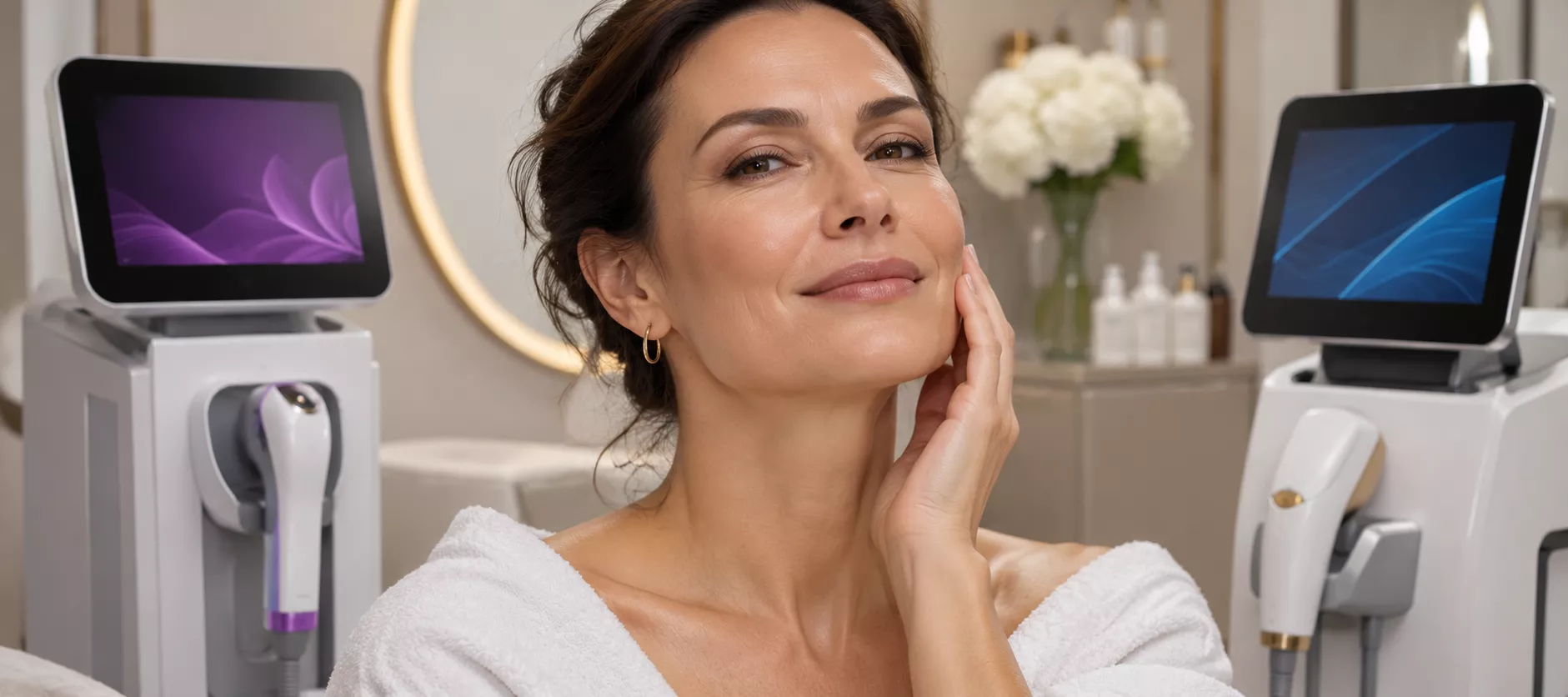
The question of Thermage FLX vs XERF is one of the most common concerns among people considering non-surgical skin tightening. Both devices use radiofrequency energy to heat the tissues beneath the skin and support collagen production. However, the frequencies they use, the way energy is distributed, and their treatment settings are not the same.
Thermage FLX is the latest generation of a technology that has been used for many years, while XERF is a newer system. Still, a newer device does not necessarily deliver better results. There is not enough direct clinical evidence to prove that one is more effective than the other. The level of skin laxity, the treatment area, and the expected improvement all play an important role in choosing between them.
What Is Thermage FLX and How Does It Work?
Thermage FLX is a monopolar radiofrequency system that works without incisions or needles. It delivers 6.78 MHz of energy beneath the skin, creating controlled heat in collagen-rich tissues. This heat causes existing collagen fibers to contract temporarily and may also encourage new collagen production over the following months. The aim is not to change the shape of the face but to give loose skin a firmer appearance.
The device uses AccuREP technology, which evaluates electrical feedback from the tissue during each energy pulse and adjusts the treatment accordingly. Its cooling and vibration features also help protect the skin surface and improve comfort. Thermage FLX treatment can be considered for the face, neck, and areas around the eyes when suitable treatment tips are used. However, it cannot be expected to tighten significant excess skin to the same extent as surgery.
What Is XERF and How Is It Different From Thermage?
XERF is another monopolar radiofrequency device that does not require incisions on the skin. Its main distinguishing feature is the ability to combine 6.78 MHz and 2 MHz frequencies within the same energy pulse. This allows the system to target different tissue depths rather than relying on a single frequency. The device offers three depth settings: superficial, middle, and deep.
XERF also provides different intensity settings, allowing treatment to be adjusted for areas such as the jawline and cheeks. Its surface cooling system helps control the sensation of heat during the procedure. However, having two frequencies does not automatically mean stronger lifting or longer-lasting results.
What Are the Differences Between Thermage FLX and XERF?
Although both treatments belong to the same technology category, they differ in how they deliver energy and the settings available during treatment. It can be misleading to assume that a higher number of frequencies means better skin tightening. The table below compares their main features.
| Feature | Thermage FLX | XERF |
|---|---|---|
| Technology | Monopolar radiofrequency | Monopolar radiofrequency |
| Frequency | 6.78 MHz | 6.78 MHz and 2 MHz |
| Energy Control | Automatic adjustment with AccuREP | Depth and intensity settings |
| Comfort Features | Cooling and vibration | Integrated surface cooling |
| Main Goal | Skin firmness and fine wrinkles | Tissue tightening at different depths |
| Surgical Procedure | No | No |
Which Treatment Tightens the Skin Better?
Both treatments may be considered for mild to moderate skin laxity. Thermage FLX has a longer history of use for facial and eye-area treatments. XERF, on the other hand, stands out for its ability to deliver energy at different depths. However, heating deeper layers of tissue does not necessarily produce a more noticeable improvement.
Someone who wants a slightly more defined jawline has different needs from someone with significant cheek sagging. Radiofrequency treatments may help with mild skin laxity, but they may not meet expectations when sagging is more advanced. For this reason, answering which treatment is better begins with identifying the actual skin concern rather than simply comparing device specifications.
Thermage FLX or XERF for the Eye Area?
The eye area requires special attention because the skin is thin and delicate. Thermage FLX has a dedicated treatment tip designed for the eye area and is used to address fine wrinkles and mild skin laxity. XERF has also been studied around the eyes using smaller treatment tips. However, not every tip can be used on every part of the eyelid. Proper eye protection and careful selection of the treatment area are essential.
When there is significant excess skin on the upper eyelid, sagging that affects vision, or true eyelid drooping, radiofrequency treatment should not be expected to provide results comparable to surgery. In these situations, eyelid surgery and non-surgical skin tightening serve different purposes. Fine lines and excess eyelid skin are not the same problem and should not be treated as if they were.
Which Is Better for the Jawline, Double Chin, and Neck?
Loss of jawline definition and mild skin laxity beneath the chin are among the concerns that may be addressed with either device. Thermage FLX aims to tighten the skin across larger areas of the face and neck. XERF offers different depth settings, allowing energy delivery to be adjusted according to the tissue structure of each area. However, a double chin is not always caused by loose skin. Fat accumulation and jaw anatomy can also affect its appearance.
| Area or Concern | Expected Approach | Important Limitation |
|---|---|---|
| Mild Cheek Laxity | Both treatments may be considered | Neither restores lost facial volume |
| Loss of Jawline Definition | Skin tightening is the main goal | Does not correct advanced sagging |
| Double Chin | Targets loose skin | Does not reliably eliminate fat deposits |
| Fine Neck Lines | Aims to improve tissue quality | Cannot completely remove deep wrinkles |
Are the Number of Sessions and Treatment Comfort Different?
Thermage FLX is generally planned as a single-session treatment. XERF may be performed in one session or as part of a treatment plan involving multiple sessions. Therefore, it would be incorrect to say that XERF always requires two sessions or that one Thermage session is enough in every case. Treatment time also depends on the size of the area. A procedure limited to the eye area will not take the same amount of time as a full-face and neck treatment.
Both procedures can cause a warming sensation on the skin. Thermage FLX uses vibration and cooling to help reduce this feeling. XERF also features surface cooling, and some treatments can be performed without numbing cream. Nevertheless, describing either procedure as completely painless would be misleading. Individual heat sensitivity, the treatment area, and the energy level all influence comfort.
When Do Results Appear and How Long Do They Last?
The feeling of tightness during the first few days after radiofrequency treatment should not be confused with the final result. Changes in collagen structure take time. Following Thermage FLX, improvements often become more noticeable over the next two to six months. XERF treatments may also produce gradual changes over several weeks and months. The extent of improvement varies, and not every treatment leads to the same visible results.
| Evaluation Period | Thermage FLX | XERF |
|---|---|---|
| First Few Days | Mild tightness or redness may occur | Mild tightness or redness may occur |
| First Few Weeks | Collagen response begins to develop | Gradual tightening may become visible |
| Following Months | Improvements may become more noticeable | Changes are assessed during follow-up |
| Long-Term Results | Results may gradually diminish | Long-term clinical data remain more limited |
Who Is Not a Suitable Candidate?
Radiofrequency treatment is not suitable for every skin concern or medical condition. Safety considerations become especially important for individuals with electronic medical devices, during pregnancy, or when there is an active problem in the treatment area. The following situations may prevent treatment or require additional medical assessment:
- Having a pacemaker, defibrillator, or similar electronic implant.
- Being pregnant or breastfeeding.
- Having an active infection, open wound, or significant inflammation in the treatment area.
- Having metal implants or certain types of permanent fillers in the treatment area.
- Expecting results equivalent to surgery when significant excess skin is present.
What Should You Consider Before and After Treatment?
A safe treatment process is just as important as achieving visible skin tightening. Before the procedure, patients should disclose any medications they take, previous cosmetic treatments, and existing implants. After treatment, the skin’s response should be monitored. Most people can return to their daily activities on the same day, but several precautions remain important:
- Inform the practitioner about recent filler injections, laser treatments, or similar procedures.
- Do not conceal active skin irritation or infections.
- Report any intense burning sensation or sharp pain immediately during treatment.
- Avoid activities that expose the skin to excessive heat for a short period after treatment.
- Seek medical assessment if redness persists or if blisters or unexpected pain develop.
Do Thermage FLX and XERF Have the Same Side Effects and Risks?
Both treatments are designed to deliver energy while protecting the surface of the skin. Temporary redness, swelling, tenderness, or a feeling of warmth may occur after the procedure. Less common complications include burns, blistering, pigmentation changes, and unwanted tissue effects. Incorrect energy settings can be particularly problematic in areas with thin skin.
A newer device is not automatically safer, just as an older device does not necessarily carry greater risks. Factors affecting safety and treatment outcomes include appropriate patient selection, correct treatment tip placement, controlled energy delivery, and careful attention to feedback during the procedure.
What Affects Thermage FLX and XERF Prices?
Comparing the cost of these treatments based only on the device name can be misleading. The treatment area, type of tip used, number of energy pulses, procedure duration, and session plan can all influence the total cost. A treatment limited to the eye area is not the same as a procedure covering both the face and neck.
A lower price should not be considered an advantage on its own. Genuine consumables, appropriate device settings, and a medical examination before treatment are important parts of the decision. Learning more about which areas Thermage FLX can treat may also help patients understand what is included in a treatment quotation.
Thermage FLX vs XERF: Which Is the Better Choice?
Thermage FLX stands out for its longer history of use and its dedicated treatment tip for the eye area. XERF offers dual-frequency technology and adjustable depth settings designed to provide greater flexibility in energy delivery. Current evidence does not show that one device is superior for every face or skin type. Both treatments primarily aim to improve skin firmness in cases of mild to moderate laxity.
When there is significant eyebrow drooping, excess eyelid skin, or advanced facial sagging, other treatment options may be considered. For example, endoscopic brow lift surgery changes the position of the tissues and does not aim to achieve the same result as radiofrequency treatment. The most important factor in the final decision is not which device is more popular, but what kind of improvement the skin actually needs.
Frequently Asked Questions
Are Thermage FLX and XERF the Same Treatment?
No. Both use monopolar radiofrequency technology, but their frequency structures and energy settings differ. Thermage FLX operates at a single frequency, while XERF combines two frequencies within one energy pulse. This difference does not necessarily lead to visibly different results in every patient.
Is XERF Newer Than Thermage FLX?
Yes. XERF is a newer device. However, being more recently developed does not prove that it offers better long-term effectiveness. Thermage FLX has a longer history of clinical use, while evidence regarding the long-term outcomes of XERF continues to develop.